Web3, the third generation of the World Wide Web, is making major ripples across finance, banking, eCommerce, gaming, real estate, logistics, and almost every other global domain by creating countless new opportunities. Today, the Web3 ecosystem powers a wide range of applications, such as decentralized finance (DeFi), NFTs, gaming, social platforms, digital identity, and enterprise applications. But developing these Web3 applications doesn’t simply require integrating digital ledger functionality, although it is a major part of Web3 Development.
A modern Web3 app, like a web application, must provide an excellent user experience, but it should also incorporate some other essential features such as multi-chain compatibility, real-time analytics, wallet integration, etc to help it stand out in the evolving blockchain ecosystem. Read this guide to explore the essential features every Web3 application should include in detail.
Also Read: Top Industries Benefiting from Blockchain Development in Australia
What Is A Web3 Application?
A Web3 application is a software program engineered on the blockchain’s decentralized infrastructure. Thus, instead of handing over control to a centralized server or some single entity, a Web3 application operates on a peer-to-peer network. Following the decentralized model, this application distributes logic, information, and even governance over the nodes of the blockchain network.
Professional Web3 development companies like Appers can build different types of Web3 platforms such as decentralized exchanges, decentralized social networks, NFT marketplaces, DeFi lending protocols, decentralized supply chain management solutions, blockchain digital identity platforms, metaverse marketplaces, DAO systems, blockchain gaming ecosystems, and more.
Must-Have Features of a Powerful Web3 Application
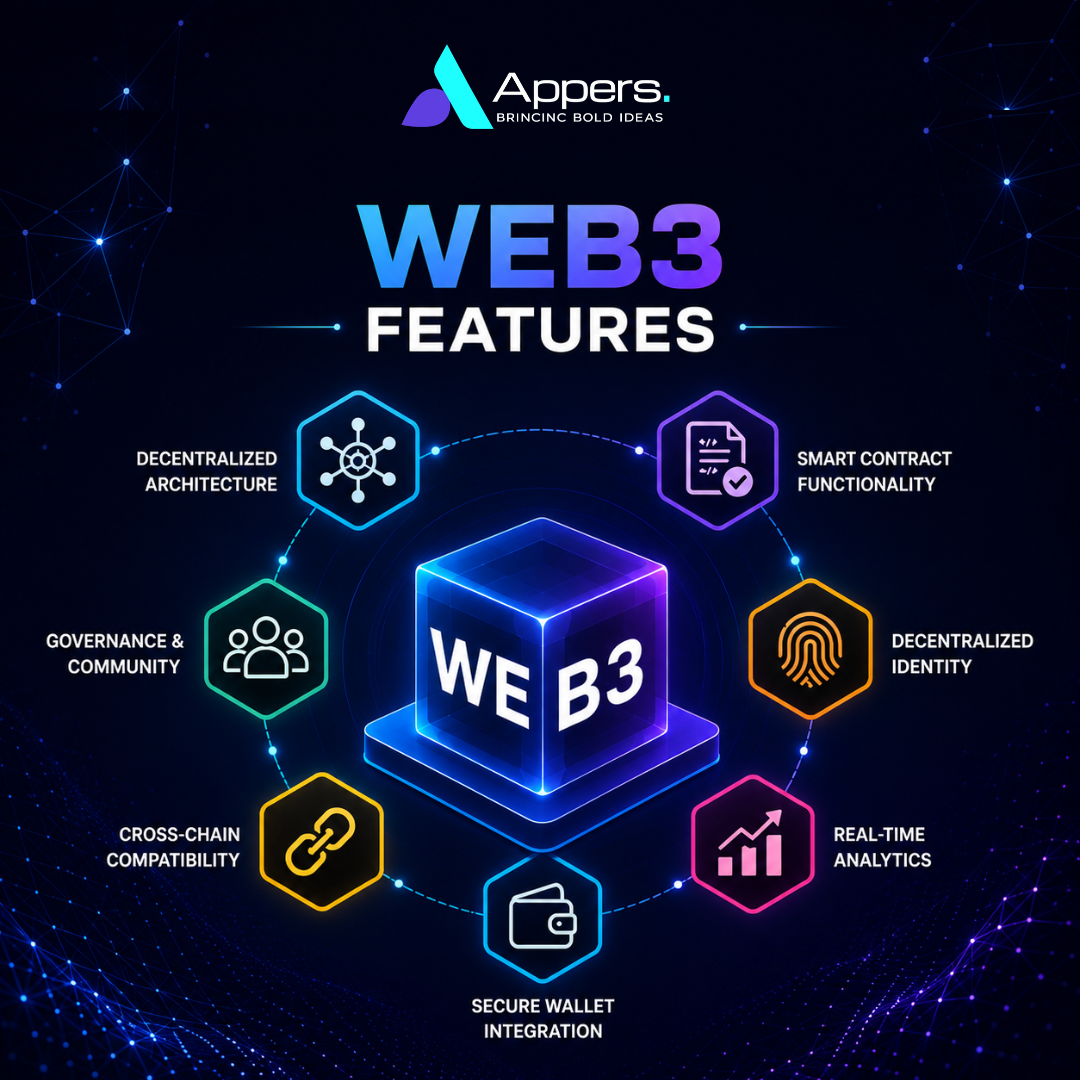
All Web3 applications share some of the defining characteristics. If you are building a Web3 platform as well, below are the key features that your modern Web3 app should include to deliver a secure, scalable, and engaging user experience:
Decentralized Architecture
The first one is quite obvious. A web3 platform needs to have a decentralized architecture to deliver true decentralization. This directly removes reliance on a central authority.
Thus, no single entity, such as a financial institution, has the power to make any kind of changes or impose rules regarding the application. This architecture also builds fault tolerance by eliminating single points of failure.
Moreover, a decentralized design architecture builds trust among users, investors, and stakeholders, as transactions and platform activities can be independently verified on the blockchain network.
To achieve this decentralized model, Web3 apps are typically built on blockchain networks such as Ethereum, Polygon, Solana, BNB Chain, Avalanche, or other Layer-1 and Layer-2 ecosystems to incorporate specific network capabilities.
Smart Contract Functionality
No matter the type, at the core of every Web3 application are smart contracts. These are self-executing programs deployed on a blockchain network. They automatically enforce predefined conditions and perform actions based on coded logic, without relying on human assistance.
Thus, from digital asset transfers to fee allocation, governance voting, royalty payments, liquidity management, rewards distribution, subscription payments, and identity verification, every single operation in these platforms can be automated using smart contracts.
This set frees businesses from the drawbacks of manual handling, such as administrative overhead, inaccuracy, data manipulation, or slower operations. However, it is important to note that these contracts are well-audited and optimized before deployment. Due to their immutable nature, the transactions are nearly impossible to reverse once executed as per the set conditions.
Intuitive User Experience (UX)
A Web3 app should always deliver the same level of usability that users basically expect from modern Web2 applications as well. No doubt, these applications deal with complexities like wallet connections, gas fees, transaction confirmations, and cryptographic signatures, but they should not overwhelm the users with them.
A well-designed user experience offers a smooth user journey with clear navigation, quick onboarding, and easy withdrawals and deposits. Moreover, the interface should be fully responsive across smartphones (iPhone and Android), tablets, laptops, and desktops.
Secure Wallet Integration
Crypto wallets act as a primary gateway for users to interact with the app. Some of the popular wallets include MetaMask, WalletConnect, Coinbase Wallet, and Trust Wallet.
Users can use these wallets to authenticate their identities, access the app, and store, manage, and transfer their digital assets. Thus, these digital asset management solutions serve as both a user identity and a secure means of conducting transactions on the application. A basic app would integrate a couple of wallets, whereas a production-grade Web3 application supports multiple wallet providers to better serve different user preferences.
Decentralized Identity and Authentication
Traditional apps require email addresses and passwords. This adds the burden of remembering passwords, which are highly vulnerable to phishing attacks, credential theft, and unauthorized account access.
Web3 apps help process passwordless and secure login with wallet-based authentication. Thus, users can verify their identity by signing a cryptographic message without having to share sensitive credentials.
Many Web3 platforms even support Decentralized Identity (DID) solutions. Users can own and manage their self-sovereign digital identities across multiple applications.
Cross-Chain Compatibility
Web3 platforms don’t operate in silos. These applications must have cross-chain compatibility to allow users to interact with Ethereum, Solana, Polygon, Avalanche, BNB Chain, Arbitrum, Base, and many other ecosystems.
Indeed, cross-chain support improves user accessibility and reduces dependence on a single blockchain. But it also helps in maintaining deep liquidity in digital asset exchanges, lending, borrowing, and decentralized finance (DeFi) platforms.
High Performance and Scalability
It is natural for even the popular blockchain networks, like Ethereum, to experience congestion during periods of high activity. But this impacts application performance.
But the Web3 ecosystem should be able to deal with an increase in demand without impacting decentralization or even performance. Layer-2 solutions are used to reduce on-chain operations and maintain smooth user experiences as the user base grows.
Analytics Dashboard
Web3 applications such as DeFi platforms, NFT marketplaces, and blockchain-based investment applications include analytics dashboards. They provide users with complete and real-time insights into their activities and assets. Basically, these dashboards display portfolio performance, transaction analytics, gas fee history, asset allocation, historical activity trends, and more.
Governance and Community Participation
The decentralization model of the Web3 solution also plays an important role in decision-making. On-chain governance mechanisms allow users to actively participate in key decisions like protocol upgrades, feature addition, treasury allocation, fee structures, and ecosystem policies.
Conclusion
From decentralized architecture to smart contract functionality and secure wallet integration, all of the key features mentioned above in the blog collectively define a software solution, a Web3 application. But building Web3 infrastructure is not as simple as traditional software development. Instilling these high-end features requires technical expertise in Web3 technologies, tools, and frameworks, and bringing real-world adoption of Web3 for the business use case. This is what Appers specialises in. We are a leading Web3 development company that assists businesses across global sectors and different scales, from startups to SMEs and large enterprises, in building Web3 platforms.
Our team provides full-scale Web3 Development Services, helping at every stage, from ideation to tech selection, architecture design, core development, smart contract development, testing, auditing, and final deployment on the mainnet. Not only that, but we also offer after-launch support for your platform, keeping it secure, updated, and high-performing at all times.
Get in touch with our experts today to discuss your Web3 application requirements and discover how Appers can help you with your project.
Also Read: Top Blockchain Development Companies In UAE: A Complete Selection Guide in 2026