In 2026, enterprises are under intense pressure to innovate their business models and invest in technologies such as artificial intelligence (AI), big data, and cloud-native applications. Indeed, these emerging technologies deliver new opportunities for growth and efficiency. Still, maintaining this extensive IT infrastructure requires enormous computing power, adding billions of dollars in upfront capital for maintenance.
Blockchain technology is largely popular for helping multiple industries solve their stubborn problems. And one of its most promising applications, Decentralized Physical Infrastructure Network (DePIN), is emerging as a practical solution to the high compute costs of enterprise infrastructure as well. In this blog, we’ll look in depth at how DePIN is transforming enterprise infrastructure and lowering compute costs.
Also Read: How to Build a Blockchain Application: Step-by-Step Development Guide
Understanding Decentralized Physical Infrastructure Network (DePIN)
But before we understand their role, let’s discuss what these networks actually are and how they work.
What Is DePIN?
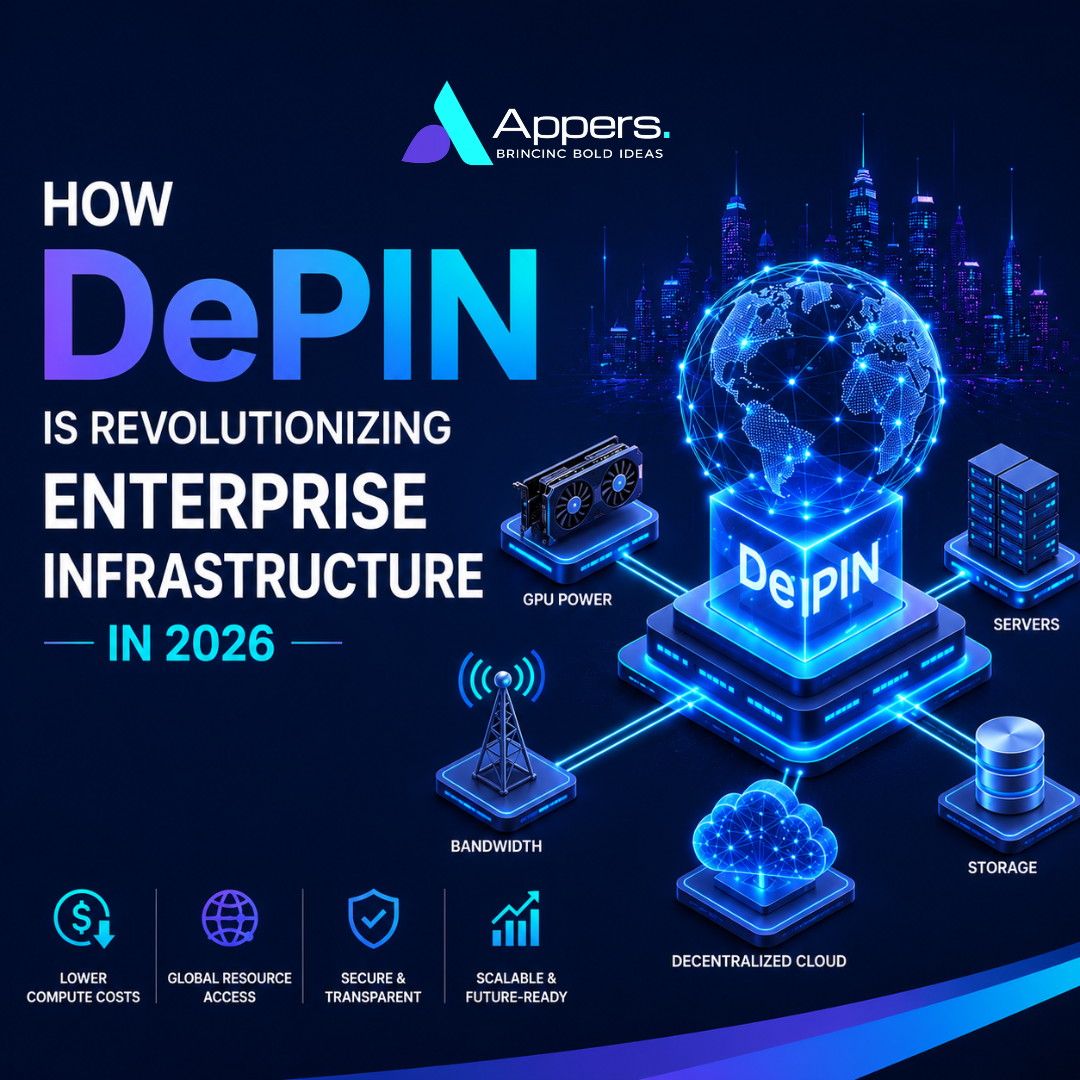
Decentralized Physical Infrastructure Network (DePIN) is basically a blockchain-based ecosystem that coordinates various components of physical infrastructure, but most importantly, incentivizes them as well. This network uses decentralized protocols and cryptographic tokens to aggregate components like routers, GPUs, CPUs, servers, networking equipment, and more, independently owned and distributed around the world.
Types of DePIN Networks
The DePIN ecosystem is divided into two main categories based on the type of resources they provide:
- Physical Resource Networks (PRNs): They basically rely on location-specific hardware. This clearly means the network value in this model depends on where devices are deployed.
- Digital Resource Networks (DRNs): DRNs operate by aggregating digital resources such as computing power, storage, and bandwidth. As a result, hardware can be installed anywhere there is an internet connection.
How Does DePIN Work?
DePIN operates on a distributed ledger architecture, where nodes connect and maintain the whole ecosystem. Let’s explore the complete working of these networks:
Resource Contribution
Different operators provide their physical resources, such as computing power, storage, or networking equipment, to power the DePIN ecosystem.
Resource Verification
The blockchain network verifies these participants by analyzing whether the contributed resources meet the defined network requirements and qualifies the components accordingly to create a reliable infrastructure.
Workload Allocation
When any business enterprise demands computing resources, the network automatically matches it as per the request by factoring in availability, performance, cost, and many more aspects.
Task Execution
Once chosen, the network of nodes manages tasks such as AI model training, cloud computing, and others by distributing them across multiple providers.
Incentives and Payments
Following the incentive model, the operator is rewarded for completing the task. These incentives are typically in the form of the network’s native cryptocurrency or tokens.
Hence, in DePIN, there are no traditional cloud providers that own and manage the entire data and infrastructure. A global network of independent operators supplies the network infrastructure and creates an open marketplace. Besides, without any manual intervention, smart contracts automatically manage coordination between participants, distribute token incentives, and handle other network operations.
Application Of DePIN In Lowering Enterprise Compute Costs
Nowadays, enterprises need more computing power than they did just a few years ago. And there are multiple reasons for that, for instance, switching to high-power AI systems, for example. Training and deploying these large language models (LLMs), recommendation engines, and computer vision applications demand thousands of GPU hours. This makes compute resources both expensive and difficult to scale. Besides, most enterprises rely on cloud ecosystems, but centralized cloud providers charge higher costs, which often increase with more usage as the business scales.
DePIN’s greatest advantage is to reduce these infrastructure expenses as follows:
Utilizing Idle Global Resources
There are millions of GPUs, CPUs, and storage devices worldwide that remain unused and underutilized. The DePIN ecosystem aggregates and connects all of these idle resources from around the world into a shared marketplace.
Thus, enterprises don’t need to build their own infrastructure and invest in new data centers. They can simply use these resources already available across the network without having to invest in them, which clearly lowers infrastructure costs. And not only that, they can only pay for the computing they consume.
Competitive Market Pricing
Centralized cloud providers have a fixed pricing structure, which is absurd oftentimes. These providers have complete control over the data. Still, enterprises have to pay extremely high fees for compute power and data storage.
DePIN marketplaces, on the other hand, don’t have that kind of costly fee structure. These networks operate depending on the supply and demand balance. Different resource providers compete to offer their infrastructure and even provide better pricing to attract enterprises. This maintains overall reasonable pricing in the network marketplace.
Enterprises greatly benefit from this as they can pay much lower compute costs for the service already filtered for their premium quality by the DePIN ecosystem.
Reduce Capital Expenditure
Purchasing enterprise-grade GPU clusters requires hundreds of millions of dollars in upfront investment. Although emerging enterprises often need these platforms, they do not have a large business budget to spend on them.
However, DePIN gives on-demand access to distributed compute resources. This eliminates the need for large capital expenditures. Thus, rather than owning the entire capital-intensive infrastructure, businesses can shift to flexible operational spending and save a great deal. Moreover, they can allocate their funds to other areas of business growth.
Improve Resource Utilization
Enterprise infrastructure is not just costly to purchase. It requires multi-level teams to manage it, and this manual infrastructure management becomes an additional expense that businesses must cover each month.
The DePIN ecosystem helps reduce these costs by making better use of underutilized computing resources. Instead of investing in additional hardware or managing idle infrastructure, businesses can use distributed resources as needed. Thus, these blockchain solutions help improve resource utilization and lower maintenance costs.
Benefits Of DePIN Networks Beyond Lower Compute Costs
Beyond lowering compute costs, DePIN enterprise Blockchain Development offers a lot of advantages, such as:
Increased Scalability
Enterprises can smoothly scale compute resources without having to make new hardware deployments or cloud capacity expansions. Besides, they don’t have to worry about the high costs that often constrain traditional corporations.
Resilience and Reliability
Centralized models feature huge data centers and consolidated infrastructure hubs. This creates the risk of single points of failure and outages. However, DePIN distributes data across diverse nodes. This decentralized data storage improves redundancy, which lowers downtime issues due to localized failures.
Improved Security
The DePIN network operates on a secure, tamper-resistant ledger that processes peer-to-peer transactions. The decentralized architecture, cryptography, and consensus mechanisms protect enterprise data and reduce security risks.
Greater Flexibility
Enterprises don’t need to settle for a single cloud provider. They can distribute workloads across decentralized infrastructure, choosing each for its specific capabilities. This creates multi-cloud environments and reduces operational risk.
Transparency
The DePIN ecosystem employs blockchain’s distributed ledger to record all transactions. It creates verifiable records that provide insights into resource usage, pricing, transactions, and everything else. This level of transparency allows enterprises to easily track costs and other details.
Different Challenges DePIN Presents For Enterprises
Indeed, DePIN is an extremely valuable blockchain application for powering enterprise infrastructures and addressing traditional bottlenecks. It creates some challenges as well, like the following:
- DePIN ecosystem is still a novel innovation. They are not widely available and have limited infrastructure access in some areas.
- Many businesses are still stuck with traditional infrastructure providers due to familiarity.
- Businesses that operate in highly regulated industries must first ensure that their decentralized infrastructure meets all applicable compliance requirements.
- Some legacy enterprise platforms lack integration capabilities for decentralized infrastructure. This creates the need for major architectural changes and updated deployment workflows.
- Although DePIN ecosystems filter contributors on strict criteria, resources are still powered by independent providers. Thus, performance can vary depending on the workload type and network conditions.
Wrapping Up
Thus, DePIN primarily connects computing resources to distributed ledger frameworks and leverages underutilized global infrastructure. Its revenue-sharing model rewards contributors for providing idle resources, and enterprises get access to distributed infrastructure without investing in expensive hardware or long-term cloud commitments.
Appers is a globally leading blockchain development company that specializes in developing futuristic decentralized infrastructure solutions. We assist enterprises every step of the way to build production-ready DePIN solutions, from ideation to tech selection, network architecture, blockchain integration, smart contract development, and node management, and even offer ongoing support.
Whether you’re looking to launch a DePIN platform or integrate decentralized compute into your existing ecosystem, our experts can assist you with your needs. Contact us today to discuss your project.
Also Read: How Blockchain 4.0 Is Transforming the Future of Decentralised Technology