Due to the countless perks of owning digital currencies, whether it’s instant cross-border settlements, low transaction fees, or the peer-to-peer transfer mechanism, individuals and businesses worldwide are investing in cryptocurrencies, CBDCs, and more. Global adoption has also greatly risen, with more than 560 million people now owning digital currencies worldwide.
As a result, businesses are investing in Cryptocurrency Wallets to accept stablecoin payments, manage treasury reserves, transfer funds between entities, settle payments with international vendors, access tokenized financial products, and even create Web3-native customer experiences.
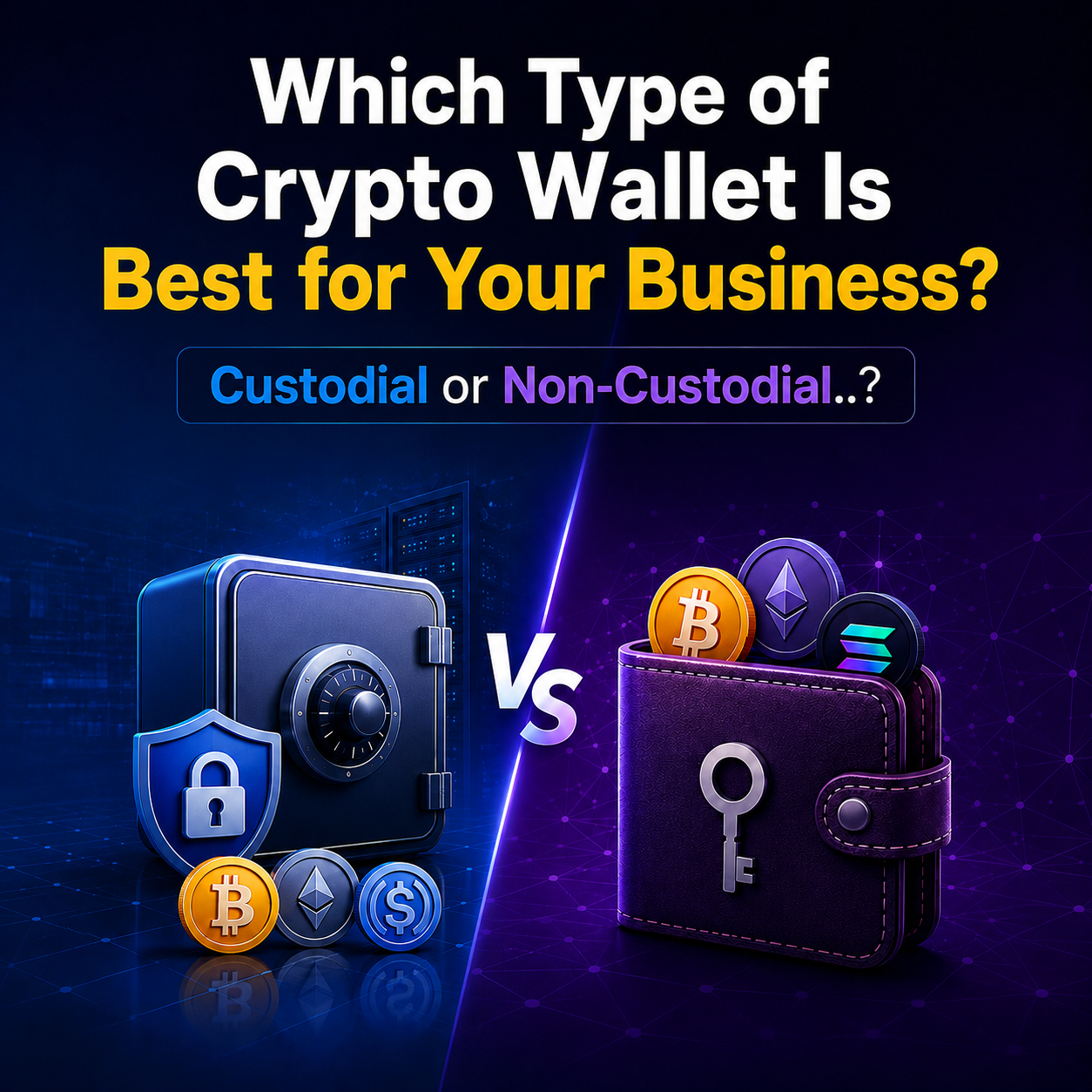
While all wallets may seem the same, they actually come in two models: custodial and non-custodial. If you’re considering creating one for your company, your decision will affect how they store digital assets, how secure they are, how much control you have over them, and even how easily you can withdraw funds from the wallet.
Also Read: Why Does Your White Label Crypto Wallet Need Built-In Exchange Features?
Read this guide to know the difference between the two wallet types and how to find the one best for your enterprise.
Understanding a Custodial Crypto Wallet
Let’s go over the first category of crypto wallets and analyze the benefits of setting up these wallets for your business and the drawbacks that come with them!
What Is a Custodial Cryptocurrency Wallet?
A custodial wallet is a type of cryptocurrency wallet in which a centralized authority or third-party service holds and manages the private keys of digital currencies on behalf of the user. This authority could be a crypto exchange, wallet provider, or some other financial institution that manages the wallet keys.
Hence, clearly, your business won’t have direct control over their private keys. But it also liberates the need to handle security, key management, account recovery, compliance, and more.
It feels more like using any other application where one logs in by entering the necessary details, and the service provider handles the rest. Besides, in the event of an issue, the customer service team is always available to assist.
Advantages of Custodial Wallets for Businesses
While the above was just a brief, here are all the benefits of using custodial wallets in detail:
Smooth User Experience
Custodial wallets are designed to make it easier for users to manage their private keys without having to deal with any technical difficulties. Hence, they feature a well-designed interface that provides easy on boarding and wallet navigation.
Account Recovery Options
Custodial wallet providers offer a layer of protection in their wallets. Thus, in the event of a private key loss, recovery is not only possible but also much easier, as custodial providers typically provide recovery mechanisms and reduce operational risks.
Regulatory and Compliance Support
Businesses do not have to worry about compliance when integrating custodial wallets. Custodial wallet providers typically ensure that their wallet frameworks comply with financial regulations, Know Your Customer (KYC) requirements, and Anti-Money Laundering (AML) standards.
Institutional-Level Security
The security of these wallets is usually excellent. High-end security measures like multi-signature protection, fraud prevention strategies, cold storage options, and thorough security monitoring systems are used to protect these wallet infrastructures.
Limitations of Custodial Wallets
Despite their high level of reliability and convenience, custodial wallets have some drawbacks, such as:
Reduced Ownership
That is obvious, given that the third party manages everything, including the private keys. So, while the assets legally belong to the owner, the custodian ultimately controls access to the funds. This is the reason behind reduced ownership and autonomy with custodial wallets.
Dependency
The centralized wallet service provider has the authority to freeze accounts or restrict access to funds in the event of intentional or unintentional errors, service outages, operational issues, and so on.
Potential Security Risks
Indeed, custodial wallets are quite secure. But, as they use a centralized storage system, assets are vulnerable to cyberattacks.
Limitations
The service provider usually imposes several restrictions on transaction approvals, withdrawal limits, and supported digital assets. These constraints can be daunting at times.
Understanding Non-Custodial Crypto Wallets
As we wrap up the first category of cryptocurrency wallets, let’s go over everything you need to know about non-custodial wallets:
What Is a Non-Custodial Cryptocurrency Wallet?
To put it simply, a non-custodial wallet is the complete opposite of a custodial model. This means that your company will have complete control over the private keys, digital assets, and associated sensitive information.
Clearly, the non-custodial model is closely related to the true nature of blockchain technology and decentralized finance, which frees the users from centralized authority control.
However, with this control over wallets comes the accountability for managing wallet security, recovery phrases, and transaction authorization. Therefore, no third party would interfere, either causing disruption or offering assistance.
These wallet solutions are available in a variety of forms, including software applications, hardware devices, browser extensions, and even full enterprise wallet management systems.
Benefits of Non-Custodial Wallets for Businesses
Here are some of the benefits of getting your own non-custodial crypto wallet for your enterprise:
Complete Anonymity
These wallets follow the concept that you have total control over your assets if you have the private keys. Therefore, there is no dependence on intermediaries or third-party services, just complete authority.
Greater Security Control
Instead of settling for whatever service providers offer, your company can create security frameworks as per specific requirements. You can incorporate different security features such as multi-signature authorization, hardware wallet integration, internal approval workflows, cold storage management, or a combination of these.
Access Web3 and DeFi Ecosystems
Since the non-custodial cryptocurrency wallet model adheres to decentralized finance, many decentralized applications just support non-custodial wallets. Hence, non-custodial solutions are ideal when developing tokenization platforms, decentralized finance solutions, or an NFT marketplace.
Lower Dependency Risks
No outside party has the authority to suddenly restrict transactions, freeze accounts, or impose operational limitations. Thus, these wallets simply remove these risks!
Challenges of Non-Custodial Wallets
Non-custodial wallets, like custodial wallets, have drawbacks, primarily in the form of increased responsibilities.
Private Key Responsibility
Since your company is the only one with control over assets, funds could be irreversibly lost if recovery phrases or private keys are misplaced.
Security Management
There is a greater responsibility to implement strong cybersecurity protocols to prevent unauthorized access.
Error Permanence
Non-custodial models frequently lack transaction reversal capabilities. So, if payment is sent to the wrong address, the move cannot be reversed.
Technical Complexity
Non-custodial solutions demand a certain level of blockchain knowledge and operational expertise to employ them for business.
Custodial or Non-Custodial Cryptocurrency Wallets: Which to Choose?
Now comes the important question: which one to choose? Well, the answer depends on what you are looking for! Both wallet models present their own set of perks and cons as well. You can choose between having control and accountability and giving up some authority for better convenience.
Here are some of the considerations that can help you make the right choice:
Security Capacity
As non-custodial models place responsibility on users, if you can invest in the wallet solution’s security to protect keys and monitor for threats, you can choose this option. Otherwise, custodial models would be a smart option.
Regulatory and Compliance Obligations
Apart from security, non-custodial setups demand internal systems to manage KYC, AML compliance, tax reporting, and audit requirements. Custodial solutions, on the other hand, often simplify compliance from their end.
Operational Complexity
Non-custodial wallets demand an in-house team with technical expertise to manage private keys, wallet infrastructure, and transaction security.
Transaction Volume and Speed
High-frequency businesses typically employ custodial platforms to simplify transactions, but businesses that interact with DeFi ecosystems may require non-custodial flexibility.
Wrapping Up
Therefore, your business would need to weigh how much control you need over your assets versus how much convenience you require to make the smart decision. Where custodial wallets prioritize usability, non-custodial wallets value ownership and accountability. Moreover, there is an option to combine models and use Hybrid approaches as well.
So, regardless of whether you choose custodial or non-custodial, you will need the assistance of a professional crypto wallet development company such as Appers.
We can not only help you find which option is best for your specific needs, but we can also assist with the development and integration of your wallet solutions. Get in touch with us to build robust crypto wallets that would keep your digital assets safe and accessible.