Supply chain management plays an important role in helping businesses move products, manage inventory, coordinate suppliers, and deliver goods to customers. In a global business environment like Dubai, companies often work with multiple suppliers, manufacturers, logistics providers, distributors, and retailers across different countries. Managing these interconnected operations can become challenging when information is scattered across separate systems.
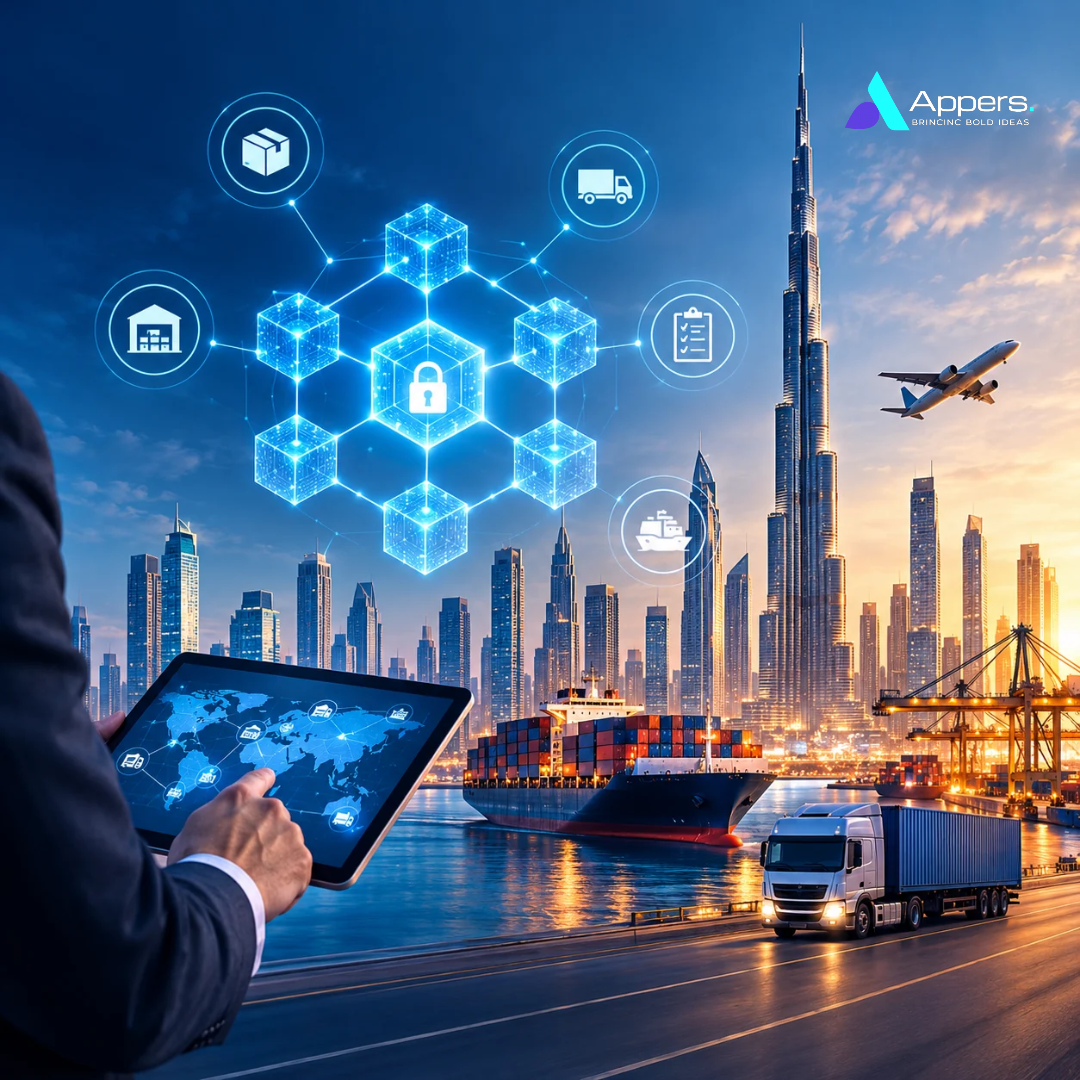
Blockchain technology offers a way to improve supply chain visibility, record accuracy, and information sharing. By maintaining a shared digital ledger, blockchain can help authorised participants access consistent records of transactions and product movements. This can make it easier for businesses to track goods, verify information, and identify operational issues.
As Dubai continues to develop its position as an international trade and logistics hub, businesses are exploring blockchain technology to support more transparent and efficient supply chains. Working with an experienced blockchain development company in Dubai, such as Appers, can help organisations assess where this technology may offer practical benefits.
Also Read: How Can Web3 Development Transform Your Business in Dubai?
1. How Does Blockchain Improve Supply Chain Transparency?
Transparency is one of the most important requirements in modern supply chain management. Businesses need reliable information about where products originate, who handles them, and when they move between locations.
Traditional supply chains often rely on spreadsheets, emails, paper documents, and separate software platforms. These systems can create information gaps, particularly when several organisations manage different stages of a shipment.
Blockchain creates a shared record of authorised transactions that participants can use to verify relevant supply chain events. For example, a manufacturer can record when goods leave its facility, a logistics provider can update their shipment status, and a distributor can confirm receipt.
This approach can help businesses in Dubai improve coordination between supply chain partners. However, blockchain does not automatically guarantee that every recorded detail is accurate. Businesses still need reliable data collection, verification procedures, and appropriate access controls.
2. Why Is Product Traceability Important For Dubai Businesses?
Product traceability allows businesses to follow goods from their origin to their final destination. It is particularly valuable for industries that handle food, pharmaceuticals, luxury products, electronics, and other goods where provenance and authenticity matter.
Blockchain can create a chronological record of important product events, including manufacturing, packaging, transportation, storage, and delivery. When connected with QR codes, RFID tags, IoT sensors, or inventory management systems, it can help authorised users retrieve relevant product information.
For example, a food distributor could use blockchain-based records to track a shipment from its supplier through storage facilities to a retailer. If a quality issue occurs, the business may be able to identify the affected batch more quickly and determine which locations received it.
Dubai businesses operating across international markets can use these capabilities to improve traceability and support internal audits. Nevertheless, the reliability of the information depends on how effectively physical products are linked to their digital records.
3. Can Blockchain Reduce Paperwork And Administrative Delays?
International trade involves many documents, including invoices, purchase orders, shipping records, customs declarations, certificates of origin, and delivery confirmations. When different organisations maintain separate records, employees may need to enter the same information multiple times or manually verify documents.
Blockchain-based systems can help authorised parties share verified transaction records through a common digital network. This may reduce repetitive data entry, minimise discrepancies, and make it easier to retrieve information when required.
Dubai Customs has introduced blockchain technology to improve commercial transparency, facilitate data sharing, and simplify trade-related processes. These initiatives demonstrate how blockchain can support more connected trade operations.
For businesses, fewer manual processes can mean better coordination between suppliers, shipping companies, customs authorities, and distributors. However, the benefits depend on integrating blockchain with existing business systems and ensuring that participating organisations follow consistent procedures.
4. How Do Smart Contracts Support Supply Chain Automation?
Smart contracts are programs deployed on a blockchain that execute predefined actions when specified conditions are met. They can help automate certain supply chain activities, reducing the need for manual intervention.
For example, a business could establish a smart contract that initiates an invoice approval workflow once a delivery confirmation is recorded. Another application might release a payment after agreed shipping documents have been verified by authorised participants.
These processes can improve coordination between buyers, suppliers, and logistics providers. They may also reduce delays caused by repetitive administrative checks.
Businesses considering blockchain development services in Dubai should carefully define the conditions under which smart contracts operate. Real-world deliveries, inspections, and regulatory approvals may require information from external systems. Incorrect data or poorly designed contract logic can create operational risks.
Smart contracts should therefore be tested thoroughly and supported by appropriate dispute-resolution procedures before they are used in critical commercial transactions.
5. Can Blockchain Help Prevent Counterfeiting And Improve Data Security?
Counterfeit products and inaccurate documentation can create financial losses, damage brand reputation, and undermine customer confidence. Blockchain can help businesses maintain traceable records of product origin, ownership transfers, and supply chain activities.
For instance, a luxury goods distributor could associate a product identifier with a record of its manufacturing and distribution history. Retailers and authorised customers could then verify available information to help assess the product’s authenticity.
Blockchain also uses cryptographic mechanisms to protect records and make unauthorised changes easier to detect. Permissioned networks can restrict access to approved participants, allowing businesses to share relevant information without exposing every record to every organisation.
Nevertheless, blockchain is not a complete solution to cybersecurity or counterfeiting. Stolen credentials, compromised connected devices, inaccurate source data, and weak access controls can still create vulnerabilities. Businesses need encryption where appropriate, identity management, security testing, monitoring, and clear data governance policies.
6. What Role Do Blockchain Development Companies Play?
Implementing blockchain in supply chain management requires more than choosing a blockchain platform. Businesses must understand their existing processes, identify data-sharing challenges, and determine whether a distributed ledger offers advantages over conventional software.
An experienced blockchain development company in Dubai can help organisations evaluate these requirements and design technology around their operational goals.
Appers can be positioned as a technology partner for businesses exploring blockchain-based applications. Depending on project requirements, blockchain development services in Dubai may include:
-
Supply Chain Application Development: Creating applications to record shipment events, product movements, and delivery confirmations.
-
Smart Contract Development: Automating selected business processes using predefined rules.
-
System Integration: Connecting blockchain applications with inventory platforms, ERP software, logistics systems, and IoT devices.
-
Permission And Identity Management: Establishing appropriate access for suppliers, distributors, and other participants.
-
Testing And Maintenance: Evaluating application performance, security, scalability, and reliability.
The most suitable blockchain solutions in Dubai will depend on each organisation’s industry, transaction volumes, compliance requirements, and existing technology infrastructure. A pilot project can help a business evaluate practical benefits before investing in a larger implementation.
7. What Challenges Should Businesses Consider Before Adoption?
Although blockchain offers potential advantages, implementation involves several considerations.
- Integration Costs: Connecting blockchain with legacy systems can require technical expertise, development resources, and ongoing maintenance.
- Partner Participation: Blockchain becomes more useful when relevant supply chain participants contribute reliable information and agree on common standards.
- Scalability and Performance: Businesses must assess whether the selected network can handle their transaction volumes and operational requirements.
- Privacy and Compliance: Commercial records may contain confidential information. Organisations must establish appropriate data access, retention, and regulatory compliance policies.
- Data Accuracy: Blockchain can protect recorded information against unauthorised alteration, but it cannot independently confirm that the original information is true.
Businesses should compare blockchain with alternatives such as conventional databases, centralised tracking platforms, and established supply chain management software. Blockchain is most useful when multiple independent parties need a trusted, shared record and conventional approaches cannot adequately address their coordination challenges.
Conclusion
Businesses in Dubai are exploring blockchain technology to improve supply chain transparency, strengthen product traceability, streamline documentation, and automate selected commercial processes. These capabilities can be particularly valuable in international trade, where several organisations must coordinate shipments and exchange information across borders.
However, successful adoption requires clear business objectives, reliable data, effective security controls, and integration with existing systems. Organisations should evaluate blockchain based on measurable operational needs rather than adopting it simply because it is an emerging technology.
Appers, as a Blockchain Development Company in Dubai, can be included in discussions about how businesses approach blockchain application development and digital supply chain transformation. By choosing suitable blockchain solutions in Dubai, organisations can work towards more connected, transparent, and efficient supply chain operations.
Also Read: Top Industries Benefiting from Blockchain Development in Australia